Northstar Financial Planners, Inc.
Northstar Financial Planners Glossary
# A B C D E F G H I J K L M N O P Q R S T U V W X Y Z

Top

12b-1 Fees: Fees charged by some mutual funds to recover sales and marketing costs associated with distributing shares of the fund. A load fund may charge an additional sales load

30-Day Wash Rule: IRS law forbidding the sale of a security in December and repurchase the following January for the purpose of declaring a year-end loss to offset capital gains.

72t: A plan that allows an IRA account holder to take distributions earlier than age 59 1/2 without incurring a 10% penalty. The account holder must take 'substantially equal distributions’ from the account for at least 5 years or until age 59 1/2, whichever comes last.

401(k) Plan: An employer-sponsored defined contribution plan for retirement. Employees make contributions to a separate account and choose from a list of investments, usually a relatively small number of mutual funds. Employers may match a portion of employees’ contributions. For tax purposes, 401(k) assets are treated similar to a regular IRA account - contributions reduce taxable income, and earnings in the account are not taxable until distributions are made. Distributions taken before age 59 1/2 are subject to income tax and a 10% early withdrawal penalty. Upon separation from an employer, an individual may elect to take a full distribution and ’roll over’ the assets to an IRA account. If the rollover is completed within 60 days of distribution, there is no tax or penalty due.

403(b) Plan: Similar to a 401(k) plan, a 403(b) is a retirement plan for public education employees, ministers and some employees of non-profit organizations.

457 Plan: A deferred compensation program available to state and federal government and agency employees. Similar to a 401(k) plan, except there are no matching contributions from the employer and it isn’t considered a qualified retirement plan under IRS rules. Participants can defer some of their annual income, and contributions and earnings are tax-deferred until withdrawal. Participants can choose to take distributions at retirement as a lump sum, annual installments or as an annuity. Distributions are taxed as ordinary income. 457 plan assets cannot be rolled over into an IRA.


Back to Top

A

Abnormal Returns: Returns in excess of overall market returns for a given period. Much of the investment advice given to the public, especially through the financial media, is focused on telling investors how to achieve abnormal returns on their investments. As a believer in efficient markets and the random walk theory, Northstar believes that higher returns are a function of accepting higher risk, not stock picking, trend analysis or market timing.

Active Portfolio Management: Practice of attempting to achieve higher investment returns by timing the purchase and sale of assets. Active managers search for undervalued assets to buy, and look to sell overvalued assets. Kenneth French, Professor of Finance at Dartmouth College, published a study titled 'The Cost of Active Investing' in 2008. That study looked at all costs associated with active investing (searching for superior returns) between 1980 and 2006, and concluded that the active investor's returns lagged a passively managed portfolio by an average of 67 basis points (2/3 of 1 percent)per year. Active management is the opposite of passive management or buy and hold strategy.

Adjusted Cost Basis (or Basis): Total cost of an asset, to subtract from the proceeds upon sale of the asset, to determine the capital gain or loss. Adjusted cost basis should reflect trading commissions, and actions such as stock splits which have occurred while the asset was owned.

ADV: See Disclosure

Aggressive Growth Portfolio: As defined by Northstar, a portfolio with more than 70% of its assets held in equities and less than 30% in cash and fixed income investments.

Alpha: Measure of risk-adjusted performance, usually calculated by comparison of the asset's excess return to the S&P 500 return.

Alternative Minimum Tax (AMT): A federal tax which eliminates many regular deductions, to ensure that wealthy taxpayers pay a minimal level of income tax. Taxpayers subject to the AMT calculate their taxes using the standard guidelines and the AMT rules, and must pay the higher of the two amounts.

Annuity: A periodic payment from an insurance company to an annuitant (or policyholder) for a specified period of time. Often used as a retirement plan, the policy holder pays into an account during earning years (the accumulation period) and then receives a regular payment during retirement. The payment amount can be fixed (constant) or variable (depending on the performance of the fund in which the payments are invested or an index). Earnings on annuities are generally not taxed until money is distributed from the account.

Appreciation: Increase in an asset's value.

Ask: An offer by the owner of an asset to sell the asset in a public exchange at a specific price. Opposite of bid.

Asset Class Allocation: How an investor distributes his or her assets among different asset classes. Decades’ worth of academic and empirical studies from Eugene Fama at the University of Chicago, Gary Brinson et al and Roger Ibbotson et al support Northstar’s strategy of investing our clients' assets in a diversified portfolio, divided by asset classes with low correlation.

Asset Classes: Different categories of investments, divided by geography (U.S., international, emerging market), company size (large-cap, small-cap, etc.), security type (stocks, bonds, cash) and sometimes sector or industry (such as real estate).

Assets Under Management: The value of all assets managed by Northstar on behalf of a client. The contract signed by the client and the Investment Advisor Representative will stipulate the management fee to be charged, which will be expressed as a percentage. This percentage is multiplied by the total Assets Under Management to determine the dollar value of the management fee.

Automated Customer Account Transfer (ACAT): A process used by Northstar’s Client Concierge to transfer a client's assets into a separate account with an institutional broker.


Back to Top

B

Back-End Load Fund: A mutual fund that charges investors a fee to sell (redeem) shares. Those fees can be significant, 5% or more. See also contingent deferred sales charge.

Back-Testing: Reviewing the historical performance of the assets within a newly created portfolio in order to create a hypothetical performance history.

Balance Sheet: While most often considered part of a business’ financial statements, can also be used to assess the financial health of individuals and households. A balance sheet provides a simple way to determine an individual or household's net financial worth, by subtracting the total debt owed from the total value of all assets owned.

Basis: See Adjusted Cost Basis.

Bear Market: A broad decline of prices within a market, usually prolonged and characterized by prices falling by 20% or more. Opposite of bull market.

Benchmark: A predetermined measure, usually an index, to compare portfolio performance. For example, common benchmarks to measure equity returns are the S&P 500 or the Wilshire 1000.

Beneficiary: The person who receives the assets of a trust or the proceeds of a life insurance policy upon the death of the grantor or insured.

Best Execution: As required by the SEC, Registered Investment Advisors periodically review the trades made by their custodians on their clients’ behalf to ensure that the trade was executed in a timely manner and at the best price available at the time.

Beta: The measure of an asset’s risk in relation to the market. For example, a stock with a beta of 2.0 would be expected to increase in value by 20% if the broader market increased by 10%. Assets with a negative beta would be expected to move in the opposite direction of the market. A beta of 0 suggests the asset is not correlated to the market at all.

Bid: An offer by an investor wishing to purchase an asset to buy the asset in a public exchange at a specific price. Opposite of ask.

Bid-Ask Spread: : The difference between the highest bid and the lowest asked price. The bid-ask spread for large, liquid securities (like Toyota or Microsoft) is usually one or two cents, while spreads for small illiquid securities can be much larger.

Blue Sky Laws: State laws covering the issuance and trading of securities, and regulation of broker-dealers.

Bond: A means for a business or government entity to raise capital through the issuance of debt. Investors who buy bonds are creditors of the bond issuer. The issuer agrees to repay the principal amount of the loan at a specified time. Interest is also paid, generally at a fixed rate for the life of the bond.

Broker-Dealer: A person or business that buys and sells securities for others, and is willing to act as the principal in one side of the deal (either buy or sell the security for its own account). Merrill Lynch and UBS are large brokerage firms. TD Ameritrade and E-trade are online discount brokers.

Bull Market: A broad upward trend in prices within a market. Opposite of bear market.

Bulletin Board: See Over-The-Counter.

Business Cycle: Repetitive trend of economic expansion and contraction. Expansion is characterized by rapid economic growth, full employment and widely available credit. Contraction is characterized by slower or negative growth, higher unemployment, and higher cost of borrowing for businesses and individuals.

Business Risk: The risk that a stockholder will lose his or her entire investment in a company if the company goes bankrupt. If bankruptcy leads to liquidation of the company's assets, creditors (including bondholders) will be paid back before stockholders, often resulting in the complete loss of the stockholder's investment. Business risk can be eliminated through diversification.

Buy and Hold: A passive investment strategy in which investments are purchased and held with no further trading activity. Northstar favors a modified Buy-And-Hold strategy, in which the initial purchase of assets is designed to achieve a certain percentage of assets by asset class, and as assets move up and down in value within the portfolio, trades are made to maintain the original balance.


Back to Top

C

Call Risk: risk that an issuer will call a callable bond if interest rates decline.

Capital: Money invested in a company.

Capital Asset Pricing Model (CAPM): A model for determining the price of risky securities, developed by William Sharpe and John Lintner in the 1960s. CAPM states that the expected return of a security is the risk-free rate plus a risk premium based on the asset’s market risk.

Capital Gain/Loss: The difference, calculated at the time an asset is sold, between the proceeds from the sale, and the cost basis. Income tax is paid on capital gains, while capital losses can be used to lower taxable income.

Capital Gains Tax: Capital gains resulting from the sale of an asset held less than a year are usually taxable at the investor’s marginal tax rate, while long term gains (sales after one year) may qualify for a lower capital gain tax rate.

Cash (or Cash Equivalents): The financial definition includes more than currency. Cash equivalents include assets that can be converted into cash immediately, such as bank checking and savings accounts, money market funds and marketable securities that mature within 90 days (e.g., notes). Similar to liquid assets.

Certified Financial Planner (CFP): A person who has met the education, experience, examination and ethics requirements of the Certified Financial Planner Board of Standards, and has been approved to use the Board’s certification marks. CFP candidates must demonstrate proficiency in many areas of financial planning, including investments, risk management, insurance, estate planning and tax management.

Certified Public Accountant (CPA): A licensed accountant who has met state standards, including education, experience, and examinations.

CFP Board of Standards: A professional regulatory agency that fosters professional standards in personal financial planning so that the public has confidence in the financial planning profession.

Charitable Remainder Trust: A trust through which the grantor can receive income and tax benefits for a specified period of time, and then leave the remaining assets to a charity.

Chartered Financial Consultant (ChFC): A financial planning title awarded by the American College of Bryn Mawr. ChFCs must meet experience and education requirements and pass exams covering finance and investing.

Churning: The practice of trading excessively in a client’s account to generate added income to the broker through commissions. Fee-only advisors, like Northstar, do not receive any compensation for executing trades, and therefore have no incentive to make any more or less trades than are required to achieve the client’s financial objectives.

Closed-End Fund: An investment company that sells shares of its funds but does not redeem shares. Investors wishing to divest fund shares must trade them on a public market, like an individual stock or bond. Not the same as a Closed Fund.

Closed Fund: A mutual fund that is not selling shares to new investors (usually because it has grown too large in size). Not the same as a Closed-End Fund.

Commission: The fee paid to a broker to execute a trade. In recent years, technology and deregulation have led to the establishment of discount brokers, who charge significantly lower commissions than full service brokers, often $10 or less for an equity trade, regardless of the size of the trade. Full service brokers usually have a staff of stock and industry analysts and offer clients recommendations, while discount brokers execute a client's order without offering advice or an opinion on a stock.

Compounding: Earnings on earnings, or interest on interest. Over a long time horizon, the effect of compounding on a portfolio is significant. For example, if $100,000 is invested for 30 years at 8% in an investment that does not offer compounded interest, the investor would receive $8,000 each year for 30 years, for a total ending balance of $340,000. However, if the interest compounds annually, the ending balance would be just over $1 million. If interest is compounded monthly, the ending total would be almost $1.1 million, which is more than three times the amount you would have without compounding.

Conflict of Interest: A situation which could result in a fiduciary having to choose between the best interest of a client and his or her own interest. Investment advisors who are registered with the SEC (like Northstar) have a strict duty to deal with conflicts in a manner that never conflicts with the best interest of the client. All conflicts or potential conflicts of interest must be disclosed to the client. Where disclosure is not adequate to ensure that the advisor will always act in the client's best interest, the advisor must abstain from the action. Northstar’s Form ADV Part II discloses conflicts of interest, as required by the Investment Advisers Act of 1940.

Conservative Growth Portfolio: As defined by Northstar, a portfolio with less than 30% of its assets held in equities and more than 70% in cash and fixed income investments.

Contingent Beneficiary:The person who receives the assets of a trust or the proceeds of a life insurance policy if the named primary beneficiary is deceased at the time of the death of the grantor or insured.

Contingent Deferred Sales Charge: A back-end load mutual fund fee that decreases over time. The full commission is charged if shares are redeemed within a short period of time (such as less than one year). If the investor retains the shares for many years, the back-end load may be eliminated entirely.

Contraction: A short period of slower or negative economic growth, higher unemployment, and higher cost of borrowing for businesses and individuals.

Contrarian: An investor or trader who follows a style of buying assets that have declined in value, and selling assets that have risen. The contrarian argument states that securities tend to trade within a range and if a security moves out of that range, it should return to its usual level. When a price movement is seen, the contrarian trader must assess whether the movement is the result of normal supply and demand factors or is the result of overreaction, trading error, automated selling or buying, a short squeeze, market manipulation or other abnormal factors. Even when a price movement is abnormal, there is no guarantee it will return to a normal range quickly or ever.

Correction: A reverse (usually rapid and short-term) in the price of an asset or a market following a long trend in movement a single direction.

Correlation: The degree to which the movements of the prices of two or more investments are related. Values close to 1 suggest a high degree of correlation, while a value of -1 suggests an inverse relationship (when one price rises, the other falls). A value of 0 suggests there is no correlation between the price movements of the investments.

Coupon: Periodic (usually semi-annual) interest payment made to a bondholder. The term stems from the largely outdated practice of issuing bonds with coupons physically attached. The coupons each had a stated maturity date, at which time they would be detached from the bond and redeemed for the stated cash value. Today, coupon interest is automatically credited to the brokerage account of the bondholder on the scheduled payment date.

Coverdell Education Savings Account: Formerly known as an Education IRA. An account created to pay for a beneficiary’s higher education expenses. Contributions are limited, and are not tax deductible. Accumulated earnings are not taxed if distributions are used to pay for qualified education expenses. Contributions are not allowed after the beneficiary reaches age 18.

Credit Risk: The risk that a debt issuer might default on its repayment obligations.

Currency Risk: See Exchange Rate Risk.

Custodian: A qualified third party broker-dealer who maintains separate accounts in the name of the client or the client’s trustee.

Custody: A financial advisor has custody of assets in his/her possession or if he/she has the ability to appropriate them.

Cyclical Stock: A stock that tends to follow the business cycle, rising when the economy is in a boom and falling during economic contractions. Housing and durable goods are two examples.


Back to Top

D

Debt Service: The amount of money spent repaying principal and interest owed to creditors.

Defensive Stock: A stock that does not decline in value with the rest of the market during a contraction or recession, usually because demand does not decline. Food, utility and tobacco stocks are considered defensive stocks.

Defined Benefit Plan: An employer sponsored plan that promises a pension benefit upon retirement, with no contribution necessary by the employee, and no separate account created for the employee.

Defined Contribution Plan: An employer sponsored savings plan in which the employee, the employer or both make contributions to a separate account for the benefit of the employee. Examples include 401(k) and 403(b) plans, profit sharing plans, employee stock ownership plans, Simplified Employee Pensions (SEP) and SIMPLE IRA plans.

Disability Insurance: An insurance policy that insures an individual in the event of an accident or illness resulting in disability that prevents the individual from working and earning income. Many employers offer employees both short-term and long-term disability plans. Short term plans generally cover the employee who is out of work for 6 months or less, while a long-term disability policy will pay the insured after 6 months, until the individual can return to work, normal retirement age, or death, whichever comes first.

Disclosure: For a financial advisor, Form ADV Part II, an SEC-required document that discloses all conflicts of interest and other pertinent information to clients and potential clients. This form is provided to all potential clients prior to entering into a written Advisor-Client Agreement, and is offered to all clients at least annually. Click here to view Northstar's current Form ADV Part II.

Discount Broker: A broker that conducts its clients' trades online and offers little or no opinions or advice on trades. Commission rates are usually much lower than those of a full-service broker.

Discretionary Authority: Permission to perform various functions, at the client's expense, without further approval from the client. Such functions include the determination of securities to be purchased or sold, the amount of securities to be purchased or sold, and the broker-dealer to be used.

Diversification: The process of reducing risk by spreading assets across many different investments, preferably in different asset classes.

Divestiture: Selling or disposing of an asset or investment.

Dividend: A percentage of a company’s profits paid to its stockholders. Note that stockholders are part owners of the company, and therefore receive a share of the company's profits. Bondholders are creditors, not owners, and receive interest, not dividends. Bondholders receive interest due before stockholders receive dividends. The amount of interest a bondholder receives is stated in the bond agreement and cannot be changed, while the dividend amount paid to stockholders is determined by the Company's directors.

Dividend Reinvestment: Automatically using dividends paid by a stock or a mutual fund to buy more shares of the stock or fund. Usually there is no transaction or trading cost to reinvest dividends.

Dollar Cost Averaging: The widely accepted practice of investing a fixed amount of money at regular intervals in a mutual fund, thus enabling the investor to buy more shares when the price of the fund goes down. As a result, the investor’s average cost per share will be lower than the average of the prices at which shares were purchased.

Double Taxation: Government taxation of the same money twice. Corporate earnings are taxed at the corporate tax rate. Net profits after tax that are distributed to stockholders as dividends are then subject to income tax.

Downgrade: A negative change in ratings for a stock, or other rated security. A downgrade by a major analyst or brokerage house can have a negative impact (at least short term) on the price of the company's security. Opposite of an upgrade.

Duration: A measure, expressed in years, of the price sensitivity of a bond to small changes in interest rates. Bonds with higher durations are generally more sensitive to interest rate changes.


Back to Top

E

EAFE: See European Australian and Far East index.

Education IRA: See Coverdell Education Savings Account.

Efficient Markets: Proponents of Efficient Market Theory believe that financial markets are efficient - stock, bond and other asset prices reflect all known information and therefore are unbiased about future prices. Therefore it is not possible to consistently outperform the market by using any information that the market already knows, except through luck. Professor Eugene Fama of the University of Chicago developed the theory in the early 1960s.

Emergency Fund: A cash reserve readily available (in a bank savings or money market account) to meet the costs of unexpected financial emergencies. As a general rule, it is recommended that households maintain three months' income in an emergency fund.

Emerging Markets: Financial markets in countries that do not have fully developed economies. Emerging markets are considered riskier than developed international markets (such as Japan and the EU) and are characterized by low per capita income, primitive or non-existent securities markets and/or low industrialization.

Employee Retirement Income Security Act: See ERISA.

Equilibrium Price: The price at which supply equals demand. In an efficient market, securities prices will naturally and quickly settle at an equilibrium price following any news or event.

Equity: Ownership interest in a company, more commonly referred to as stock. In real estate, the difference between the market value and the debts claimed against the property.

ERISA: A federal law establishing minimum standards for company-sponsored pension plans, to protect the interest of employees participating in such plans. Among the key provisions are disclosure of financial information and standards for plan trustees.

Estate Planning: Preparing while an estate owner is still alive for the orderly administration, management and distribution of a person’s assets and liabilities upon death. The most basic component of estate planning is a will. Trusts, insurance, and powers of attorney are other important components to carry out the wishes of the estate owner and reduce the tax burden and other liabilities on the beneficiaries of the estate.

Estate Tax: Often referred to as the ’Death Tax’, estate tax is levied by the federal and state governments on the transfer of property at death. 'Property' includes any tangible personal property, real estate, jointly owned property, life insurance, employee benefits, certain gifts, and other assets. Proper estate planning can help to reduce the potential impact of estate taxes.

ETF: See Exchange Traded Fund.

Ethics: Standards of conduct or judgment. The CFP Board of Standards publishes and enforces a code of ethics for all Certified Financial Planners in order to promote the reputation of the financial planning profession. The CFP Boards ethics standards are fully incorporated into Northstar’s business standards.

Europe, Australia, and Far East index (EAFE): One of the most commonly used international stock indexes, created by Morgan Stanley.

Event Risk: The possibility that an event will negatively impact a company's credit rating and/or its ability to pay interest and principle to bondholders.

Exchange Rate Risk: The risk that an international investment may decrease in value because of changes in the currency exchange rate. Also called currency risk.

Exchange Traded Fund: A collection of assets similar to a mutual fund, but which trades on a live exchange. Many ETFs are index funds. Because they do not recalculate their net asset value during the day, ETFs can trade higher or lower than their net asset value.

Execution: The process of completing the purchase or sale of securities. Although the brokerage account usually reflects the trade as soon as it is executed, actual settlement (payment and transfer of ownership) occurs between one and five days after execution. (Mutual fund settlement typically takes one day.) International settlements can take significantly longer.

Expected Return: What an investor expects to receive for investing in a given asset, given a probability distribution for the possible rates of return. Expected return equals the risk-free rate (usually the U.S. Treasury rate) plus a risk premium (an added expected benefit for taking on added risk) multiplied by the asset's beta. EXPECTED RETURN IS NOT THE SAME AS ACTUAL RETURN. Any investment carries the possibility of returns lower than the expected return or even loss of invested capital.


Back to Top

F

Fallen Angel: A bond that has fallen from investment grade to a 'junk' rating. See also high yield bonds.

FDIC: See Federal Deposit Insurance Corporation.

Federal Deposit Insurance Corporation (FDIC): The U.S. government agency that insures bank deposits. Generally, each named account holder is insured for up to $100,000 in the event the bank cannot repay principle due to insolvency. Note that neither federal insurance nor any other insurance can protect the investor against principal losses due to falling securities prices.

Fee-Only Advisor: An investment advisor (like Northstar) that does not receive commissions, incentives or any other form of direct or indirect compensation for the selling of a specific investment product. Revenue comes solely from the fees charged (usually quarterly) directly to clients for portfolio management and other financial services.

Fiduciary: Someone who acts on behalf of and for the benefit of another. In a financial relationship it is characterized by control over assets, finances or actions. Investment advisors have a stronger fiduciary duty than broker-dealers.

Financial Planning: The process of evaluating the financial condition of an individual or household and developing a plan to help them achieve their financial objectives. Steps in the process typically include 1) establishing a relationship with the client, 2) doing a background analysis, 3) establishing the financial objectives, 4) developing a plan, 5) implementing the plan, and 6) measuring performance.

Fixed Annuity: See Annuity.

Fixed Costs: In viewing personal or business expenses, it is helpful to divide fixed costs from variable costs. Fixed costs generally do not change based on usage or other factors, and include mortgage payments, car payments and life insurance. Variable costs include the electric bill, vacation expenses and occasional gifts to relatives or friends.

Fixed Income Investment: An investment that pays a fixed dollar amount, usually expressed as an interest rate. U.S. Treasuries, municipal and corporate bonds are the most common fixed income investments.

Form ADV: See Disclosure. Click here to view Northstar's current Form ADV Part II.

Front-End Load: A sales fee paid at the time of purchase of a mutual fund.

Front Running: The practice of a broker executing a trade for his or her own benefit with advance knowledge of a block transaction that will influence the price of the security. The SEC prohibits this practice.

Full-Service Broker: A broker who provides clients advice and opinions on security selection, as well as financial planning services. Full-service brokers managing a client's brokerage account do not have the same fiduciary responsibility as independent Registered Investment Advisors, and often select investments from a relatively small list of commissionable products or broker-recommended products.

Fund of Funds: A mutual fund or hedge fund that invests in other mutual funds.

Fundamental Analysis: Security analysis that focuses on a company's financial statements and all other public information. By contrast, see Technical Analysis.


Back to Top

G

Gambling: Putting money in an investment with a negative expected return. Some claim that investing in capital markets is gambling; Northstar disagrees. Capital markets offer a positive expected return. While not all investments or time periods offer a positive return, over time, capital markets have shown a remarkable ability to provide investors with returns in excess of inflation and the risk-free rate.

GDP (Gross Domestic Product): The value of all goods and services produced within a country. The primary measure of the economy’s health is the percentage growth in GDP year over year.

Gift Tax: Federal tax imposed upon a person who gives assets of more than $12,000 in a year (or $1 million in a lifetime) to any single recipient.

Global Fund: A fund that invests in both domestic and foreign securities. By contrast, an international fund invests in securities markets outside of the U.S.

Goldilocks Economy: A growing economy which isn't growing so quickly as to give investors concerns about inflation. Like the porridge in Goldilocks, "not too hot; not too cold; just right."

Growth and Income Fund: A mutual fund that invests primarily in growth and income stocks.

Growth Fund: A mutual fund that invests primarily in growth stocks.

Growth Stock: A stock with a high price-to-earnings ratio or price-to-book ratio. Growth stocks typically pay little or no dividend but funnel retained earnings back into the business to fuel future growth, thus leading investors to speculate that future earnings will increase the stock price. Historical returns have shown the reverse to be true, with value stocks having outperformed growth stocks in the long run.


Back to Top

h

Hedge Fund: An actively managed fund that uses a variety of techniques to attempt to enhance returns, such as entering short positions, trading short-term and trading options and futures contracts. Hedge funds typically charge both a management fee (usually about 2% of assets) and a performance fee (20% of profits or more). There is very little transparency into the transaction in the fund, as those transactions represent the manager's unique style and are therefore considered confidential business practices.

High-Yield Bonds: Sometimes referred to as junk bonds, high-yield bonds are issued by businesses that do not qualify for ’investment-grade’ ratings by one of the leading credit rating agencies. Issuers of high-yield bonds must pay a higher interest rate to compensate investors for the increased risk of default - not paying interest or principal in a timely manner.

Household: A common investment advisor's practice of combining the values of several accounts related to family members in a single household, for purposes of negotiating a lower fee.


Back to Top

I

Immunization Strategy: Constructing a bond portfolio to eliminate the portfolio's interest rate risk, by matching the duration of the portfolio to its liability. Typically used by pension funds, insurance companies and banks.

Income Fund: A mutual fund that has a primary goal of providing current income to the fund owner, by concentrating investment in high dividend stocks.

Index Fund: A mutual fund that emulates the composition of a specific market index. It is expected that the performance of the fund will be close to the performance of the underlying index.

Individual Retirement Account (IRA): A contributory account that gives the investor many tax advantages. In a traditional IRA, contributions are tax deductible, and no taxes are due until distributions are made. In a Roth IRA, contributions are not tax deductible, but no taxes are owed on capital gains if distributions are taken after age 59 1/2. If distributions are made from an IRA before age 59 1/2, income tax and a 10% penalty may be imposed by the IRS.

Inflation Risk: The risk that the rate of return on investments will not keep pace with the inflation rate, resulting in a loss of purchasing power.

Inside Information: Nonpublic information known to company insiders, such as employees, vendors or analysts. Buying or selling shares of a company’s securities based on insider information is illegal under SEC rules, and can result in fines, forfeiture of profits and jail time. If an insider shares such information with a non-insider (a friend, relative or neighbor for example) and the non-insider uses the information to make a profit in the securities market, both parties could be held criminally and civilly liable.

Insurance: The spreading of risk from the individual to a large group. Each member of the group pays a small amount (premium) to form a reserve to pay anyone in the group experiencing an insured loss.

Interest: The money paid to lenders by a borrower. Because lending (to a high-credit borrower) is less risky than investing through stock ownership, the interest return for lending is typically lower than the expected return for investing.

Interest Rate Risk: The risk that a bond will decline in value if interest rates rise. For example, if a bond costs $1,000 and pays 4%, it will pay $40 per year for the life of the bond. If interest rates rise to 5%, the bond is no longer worth $1,000, because an investor could buy a 5% bond for the same $1,000 and receive $50 per year. The price of the 4% bond would be discounted, so that the $40 annual interest plus the repayment of principal at maturity would represent a 5% return rather than 4%.

International Fund: A fund that invests in securities traded in markets outside of the U.S. By contrast, a global fund invests in U.S and international securities.

Inverted Yield Curve: A relatively rare occurrence in which short-term interest rates are higher than long-term rates. Also known as a negative yield curve.

Investment Advisers Act of 1940: Sweeping legislation giving the SEC authority to register and regulate financial advisors. Among the key provisions are the requirement to disclose conflicts of interest and a prohibition on fraudulent or misleading advertising or claims.

Investment Advisor Representative: Representatives of a Registered Investment Advisor (such as Northstar) qualified and authorized to give investment advice to clients.

Investment Company: Investment companies pool the assets of many investors and buy a packaged product of securities, called a mutual fund.

Investment Company Act of 1940: Federal law that gives the SEC authority to register and regulate investment companies.

Investment Grade: A bond with a high credit rating given by one of the top credit rating organizations, such as Moody's or Standard and Poors. Bonds that fail to gain an investment grade rating are called high-yield bonds (because they have to offer a high return for the added credit risk) or junk bonds.

Investment Risk: The possibility that an investment may decline in value or produce a lower-than-expected return. Investment risk varies depending on the type of investment, and usually, expected return is higher if investment risk is high. U.S. Treasury securities are considered among the safest available investments, as they have a fixed rate of return and are backed by the full faith and credit of the U.S. Government. Accordingly, they offer a relatively low rate of return. Investment grade corporate bonds have a slightly higher risk, and usually offer a slightly better rate of return. Equity investments (stocks), which have more risk than bonds, offer a higher expected return, with higher risk stocks (small companies, international companies) expected to give a higher return than lower risk stocks (large U.S. companies). However, equity securities are more volatile than fixed income investments, which means a much wider range of possible returns over any given time frame, with the possibility of no return or negative return for any given stock.

Irrevocable Trust: A trust that gives the trustee control over the assets in the trust. The trust cannot be modified once established.


Back to Top

J

January Effect: The belief that stock prices tend to rise the first few days of January. Studies of historical trends support that this used to be true only for small-capitalization stocks. However, in recent years, as the trend has been given more attention in the financial media, there has been less evidence of a January effect.

Joint and Survivor Annuity: An annuity intended to make payments to two people, and to continue to make payments until both die. Because this type of annuity will usually have a longer payout than a single annuitant policy, the payment rate is lower.

Junk Bonds: See High-Yield Bonds.


Back to Top

K

Keogh Plan: A pension account for self-employed individuals, offering the advantage of tax deferral.

Kiddie Tax: Tax owed on a child's investment income if the income amount is more than $1,400.


Back to Top

L

Ladder Strategy: A bond portfolio composed of equal investments in bonds of every maturity within a range.

Large-Cap Stock: Shares issued by a company with a market capitalization of $5 billion or more.

Legal List: A state agency's list of approved low-risk securities (mostly high-quality bonds), which are considered the only acceptable holdings for fiduciary institutions such as savings banks and trust funds. Under the legal list approach, the main investment duty of the fiduciary is preservation of capital. Most states impose the less-strict prudent man standard.

Legislative Risk: See Regulatory Risk.

Level Load: A mutual fund that charges an annual 12b-1 fee, usually 1% of assets. The fund may also charge a front-end load and/or back-end load.

Life Annuity: An annuity that pays until the death of the annuitant.

Liquid Assets: See Cash.

Liquidity: Level of trading activity in a security. A highly liquid security trades frequently and therefore gives a buyer or seller the opportunity to enter or close a position with ease. An illiquid security carries the risk that a buyer or seller will be unable to easily enter or close a position, or will have to increase his or her bid, or lower his or her ask, to make a trade.

Listed Security: A stock or bond that is traded on one of the registered securities exchanges in the United States. There are many advantages to being listed both for the issuer and the investor, including: (1) orderly marketplace; (2) liquidity; (3) fair price; (4) accurate and continuous reporting; (5) company information; and (6) strict regulation to protect security holders. Securities that are not listed are called Over-The Counter (OTC).

Load Fund: A mutual fund that charges a sales fee, typically 4% to 8% of assets. A load fund can be front-end, back-end or level load. Some "no-load funds" charge 12b-1 distribution fees. A true no-load fund has neither a sales charge nor 12b-1 charges.

Long-Term Capital Gain: Profit on the sale of a capital asset held longer than 12 months, and thus eligible for long-term capital gains tax treatment.

Long-Term Debt: A loan obligation having a maturity of more than one year.


Back to Top

M

Macroeconomics: A branch of economics concerned with the performance and structure of an entire national or regional economy.

Maintenance Call: : See Margin Call.

Managed Account: account for which a broker or advisor has discretionary authority.

Management Fees: Fees charged for management of the client's investments. A fee-based advisor will charge a management fee to the client based on a percentage of assets under management. There is also a management fee charged by the investment company for management of a mutual fund.

Margin: A loan from a broker to an investor to allow the investor to buy additional securities For example, if an investor deposits $50,000 into a margin account, he or she may borrow up to $50,000 more from the broker (the exact amount is determined by the exchange) and purchase up to a total of $100,000 in securities.

Marginal Tax Rate: The tax rate applied to an individual's next dollar of income.

Margin Call: A broker's call for additional money or securities when an investor's margin account falls below a required level. Also known as maintenance call.

Marital Deduction: A tax rule allowing spouses to transfer unlimited amounts of property to each other.

Market: A public place where buyers and sellers make transactions, either directly or through agents or intermediaries. In business and finance terms, generally refers to the stock market.

Market Capitalization (or Market Cap): The market value of a public company, calculated by multiplying the price per share of stock times the number of outstanding shares.

Market Risk: The risk that a security will fall if the larger securities market falls over an extended period of time. This type of risk cannot be eliminated through diversification. Also called systematic risk.

Market Timing: A strategy in which the investor tries to be in the market when prices are rising and out of the market when prices are falling. Decades of empirical and academic research have failed to find anyone who can consistently achieve abnormal profits, net of trading costs and fees, through market timing.

Marketable Securities: Liquid securities that can easily be converted to cash.

Marriage Penalty: Income tax rule that penalizes married couples because they pay more tax on a joint tax return than they would if they filed individual returns.

Micro-Cap Stock: Shares issued by a company with a market capitalization of less than $50 million.

Microeconomics: Behavior of individual companies, industries, or households.

Mid-Cap Stock: Shares issued by a company with a market capitalization between $1 billion and $5 billion.

Misery Index: An index quoted most frequently during periods of high unemployment and inflation, often used for political purposes or to measure consumer confidence.

Moderate Growth Portfolio: As defined by Northstar, a portfolio with 30% to 49% of its assets invested in equities and the remainder in cash and fixed income investments.

Modern Portfolio Theory (MPT): Principles of risk-return trade-off and diversification through investments with low correlation. The end goal of MPT is to construct a portfolio that maximizes the expected level of return given a particular level of volatility or risk.

Momentum: The concept that prices tend to follow a trend in the short run. A momentum trader will buy stocks that have risen in price and sell those that have fallen.

Money Market Fund: A mutual fund that invests in short-term money market instruments, such as U.S. Treasury bills, commercial paper, certificates of deposit, and repurchase agreements. While considered relatively safe from investment risk, there is the possibility that the value of a money market fund could decline. Unlike a deposit in a bank ’money market’ savings account, money market mutual funds are not insured or guaranteed by the Federal Deposit Insurance Corporation or any other government agency. A decline in the underlying assets in a money market fund could lead to the ’write down’ of the assets by the issuing investment company. Also, given the relatively low rate of return, there is a significant possibility that the growth of a money market fund will fail to keep pace with the rate of inflation.

Monte Carlo Simulation: A complex model that calculates a probability distribution by looking at thousands of possible outcomes or trial runs. This type of modeling can be useful in retirement planning to give the investor an idea if he or she is saving enough for retirement, by determining the probability that, given the current savings rate and other assumptions, the investor's money will last through his or her entire retirement.

Mortgage-Backed Security (MBS): An investment backed by a pool of mortgage loans.

Municipal Bond: A bond issued by state or local government to raise funds for special projects, such as schools, roads and utilities. The interest received is often ’triple exempt’, exempt from federal, state and local taxes.

Mutual Fund: A collection of securities owned by a group of investors and managed by an investment company. The mutual fund's prospectus or charter determines the type of investments that will be owned by the fund.


Back to Top

N

NASD: See National Association of Securities Dealers.

NASDAQ: See National Association of Securities Dealers Automatic Quotation System.

National Association of Securities Dealers (NASD): Nonprofit organization which regulates the OTC market.

National Association of Securities Dealers Automatic Quotation System (NASDAQ): An electronic system that provides price quotes for thousands of OTC stock issues.

NAV: See Net Asset Value.

Negative Amortization: A loan repayment schedule in which the periodic payment does not exceed the interest accrued during the period. As a result, the outstanding balance of the loan increases.

Negative Yield Curve: See Inverted Yield Curve.

Net Asset Value (NAV): The actual value of a mutual fund's investments. The NAV is usually recalculated after the end of each trading day to account for price changes in the securities held by the fund. Once the NAV is determined, open orders to buy or redeem mutual fund shares can be filled. Shares are bought or sold at the NAV plus any sales charges (loads and 12b-1 fees).

Net Present Value (NPV): The sum of expected future cash flows minus the cost. Future cash flows are discounted by a certain percentage to reflect the time value of money. Businesses consider the NPV of any major investment decision, such as developing and marketing a new product. Individuals can use NPV to determine how much money they need to invest today, and what rate of return they would need to achieve, to have a certain amount in the future for college or retirement.

Net Proceeds: The amount received from the sale of an asset after deducting the original cost and all transaction costs, such as trading commissions or sales charges. Capital gains taxes are determined based on the net proceeds.

Net Worth: For businesses and individuals, net worth is calculated by summing the value of all assets owned and subtracting the total amount of debt owed (liabilities). A company or individual with more liabilities than assets has a negative net worth.

No-Load Fund: A mutual fund that does not charge a sales fee. Some "no-load funds" charge 12b-1 distribution fees. Northstar considers a true no-load fund to have neither a sales charge nor 12b-1 charges. Such a fund will only charge a management fee.

Nominal Interest Rate: The actual stated interest rate, unadjusted for inflation. The inflation-adjusted interest rate is called the real interest rate.

Noncontributory Pension Plan: A pension plan that is fully funded by the employer, and thus requires no employee contribution. Such pension plans must conform to ERISA rules.

Non-Discretionary Authority: Where discretionary authority is not granted, the advisor will not purchase or sell securities on behalf of the client without specific authorization for the trade.

Normal Growth Portfolio: As defined by Northstar, a portfolio with 50% to 70% of its assets invested in equities and the remainder in cash and fixed income investments.

Normal Yield Curve: See Positive Yield Curve.


Back to Top

O

Open-End Fund: An investment company that sells shares of its mutual funds and repurchases (redeems) them when an investor wishes to divest fund shares. Opposite of a closed-end fund.

Opportunity Cost (or Opportunity Risk): The risk that an investor will forgo the chance to receive a better return by placing their funds elsewhere. For example, if an investor purchases a 10-year bond that pays 6%, and interest rates on 10-year bonds then increase to 8%, the investor has an opportunity cost because he or she is receiving 6% and cannot use that money to get the 8% return available to other investors.

Over-The-Counter (OTC): A decentralized market of unlisted securities (stocks that don't meet the requirements to be listed on the NASDAQ stock-listing system). Also referred to as bulletin board stocks.


Back to Top

P

Par Value: The face value of a bond, the amount an investor will receive when a bond reaches maturity. A bond that trades above par value is called a premium bond, while a bond that sells below par value is called a discount bond.

Parking: Putting money into a safe liquid investment (such as a money market fund) while awaiting another investment. For example, if an investor anticipates spending a large amount of money in three months to purchase a house, he or she may want to protect the amount of money needed from the short-term volatility of capital markets by liquidating the required amount and parking it in a money market fund.

Passive Management: An investment strategy in which the investor buys and holds a portfolio of assets. In a modified passive management strategy, trades may be conducted to rebalance the portfolio to its original asset class mix. For example, if a portfolio is intended to be 50% equities and 50% fixed income investments, but over time the higher performance of equities has changed to portfolio mix to 57% equities and 43% fixed income, the account would be rebalanced by selling the excess 7% equities and buying the same amount of fixed income securities. Often passive management is applied to index funds, and trades in the fund only occur when changes occur in the composition of the underlying index.

P/E Ratio: See Price-to-Earnings Ratio.

Penny Stock: An OTC stock that typically trades for less than $1 per share.

Performance Fund: A mutual fund that focuses on growth stocks with low dividends and high risk.

Period-Certain Annuity: An annuity that guarantees payments to the annuitant for a specific time period.

Political Risk: Risk associated with international investing, especially in emerging markets. The risk that political changes could lead to loss of investment, for example, nationalization of an industry.

Positive Yield Curve: Also called a normal yield curve. When long-term bond interest rates are higher than short-term rates. This is considered a normal curve because investors in long-term bonds expect to be rewarded with a higher return for incurring more risk (i.e., interest rate changes have a larger impact on long term bonds than short term bonds).

Power of Attorney: Written legal authorization allowing a person to act on behalf of another, particularly in the buying and selling of assets.

Preferred Stock: A security that combines features of bonds and stock. Preferred shares pay a dividend, like a stock, but the dividend is usually a fixed amount, stated as a percentage of par value or a fixed dollar amount, like a bond. Preferred stock dividends must be paid before common stockholders can receive dividends. Also, in the event of bankruptcy, preferred stockholders can recover from company assets before common stockholders but after bondholders. Preferred stock does not usually carry voting rights.

Price-to-Book Ratio: The price of a stock divided by its book value, taken from its balance sheet.

Price-to-Earnings (P/E) Ratio: The price of a stock divided by its prior year earnings. High P/E ratios are indicative of growth stocks, which some investors believe will offer above average capital appreciation in the future. A low P/E ratio suggests a value stock, which investors may buy if they believe the stock price is less than the NPV of all future cash flows (a.k.a. intrinsic value).

Prime Rate: The interest rate on loans extended to a bank’s best customers.

Private Placement: The sale of a security directly to a limited number of investors. Private placement avoids the requirement that a security be registered with the SEC, as is required for public offerings.

Probate: A court-supervised process in which a judge reviews a will and an executor distributes the assets of an estate as specified by the decedent.

Prospectus: An official document, usually filed with the SEC, which describes a mutual fund or stock to prospective investors. A mutual fund prospectus states the fund's investment objectives, risks, and fees.

Prudent Man Standard: A requirement that a fiduciary or trustee should "observe how men of prudence, discretion and intelligence manage their own affairs considering the probable income as well as the probable safety of the capital to be invested." Under this standard, there are no restrictions on specific investments, as is the case with the legal list approach. Diversification is essential, with the standard of prudence applied to the whole portfolio, not to each investment. Of central consideration is the trade-off between risk and expected return.

Public Offering: The offering of a security for sale to the investment public. Requires compliance with SEC registration requirements. Usually the public offering is conducted and underwritten by an investment banker, at a price agreed upon with issuer. Once shares are issued in a public offering, they are traded on one or more exchange.

Purchasing Power Risk: See Inflation Risk.


Back to Top

Q

Qualified Tuition Program (QTP): See Section 529 Plan.


Back to Top

R

Random Walk: Part of efficient market theory, the belief that stock price changes which are not driven by specific company, industry or market events, are random, accidental or haphazard; there are no underlying patterns which an investor can use to consistently achieve abnormal returns.

Real Estate Investment Trust: A company that pools investors’ money and invests in real estate or loans secured by real estate. Most of the income generated from the investments (tenant rent or mortgage payments) are then returned to investors as dividends.

Real Interest Rate: The stated interest rate, adjusted for inflation. The unadjusted interest rate is called the nominal interest rate.

Rebalancing: Conducting trades in a portfolio to return it to its desired mix of assets. An example is given under the definition for passive management.

Recession: A temporary downturn in an economy. Though the definition of a recession specifically indicates two consecutive quarters of falling GDP, a slowdown in growth accompanied by high unemployment and rising prices may be referred to and generally accepted as a recession.

Registered Investment Advisor: A business or individual who gives investment advice and registers with the SEC as required by the Investment Advisers Act of 1940. Northstar Financial Planners, Inc. is a Registered Investment Advisor. Financial advisors authorized by Northstar to give advice to clients are Investment Advisor Representatives (IARs).

Regulatory Risk: Also called legislative risk, the risk that new laws or regulations will impact the value of an investment.

Reinvestment Risk: Most commonly associated with coupon bonds and callable bonds, the risk that interest payments or repaid principle cannot be invested at the same interest rate the bond pays. For example, if a callable bond pays an interest of 8% per year and interest rates fall so that the company could issue debt for 5%, the company might call the bond and issue new 5% bonds. The bondholder would have his or her principle back but would not be able to achieve an 8% return without investing in a riskier asset. Even if the bond were not called, the interest payments received could not be reinvested at 8% without incurring more risk.

REIT: See Real Estate Investment Trust.

Required Minimum Distribution (RMD): The minimum amount that a retirement account holder must withdraw each year starting at age 70 1/2. RMDs from an employer-sponsored retirement plans (like a 401(k)) may be postponed if an individual works beyond age 70 1/2 and is still employed by the company. Penalties for not taking an RMD as required are substantial.

Reverse Mortgage: A mortgage in which a homeowner receives payments rather than making them. The homeowner is borrowing against the equity in the property, but retains title, and makes no payments while residing in the home. When the owner moves or dies, the property is sold, and the loan repaid.

Revocable Trust: A trust that can be altered in which income-producing property passes directly to the beneficiaries at the time of the grantor's death. Because the trust can be altered, the assets remain a part of the grantor's estate and they are taxed as such.

Risk: The degree to which the return on an investment is uncertain. Also referred to as volatility. Risk, and the tradeoff of risk and reward, are the primary considerations in building a diversified portfolio to help clients achieve their investment goals. Riskier assets are expected to give higher returns over the long run, but tend to be poor short term investment choices because their volatility leads to a higher probability of a short term loss compared to less risky assets, especially money market funds and U.S Treasuries. Many different types of risk are defined in this glossary, including systematic risk, unsystematic risk, business risk, credit risk, event risk, exchange rate risk, inflation risk, regulatory risk, political risk, and opportunity risk.

Risk-Free Rate: The expected return on an investment with no risk of capital loss and a fixed, guaranteed rate of return. The interest rate on U.S Treasuries is usually considered to be the risk-free rate.

Risk Management: A process by which risks are identified and evaluated, and methods are selected to manage those risks. One of the most common methods of dealing with different risks to individuals and businesses is the use of insurance, which is designed to spread risk over a large group, greatly limiting the potential loss to any one group member.

Risk Premium: A higher expected return on an investment based on the assumption of more risk. For example, investing in corporate bonds is riskier than investing in U.S Treasuries, as there is virtually no possibility of capital loss if U.S Treasuries are held to maturity, but even the most solid corporations could end up in bankruptcy. Therefore, investors expect a risk premium, or a higher return for investing in a corporate bond compared to the rate they would expect for investing in U.S Treasuries. An even higher risk premium is expected for investing in equities, which are more volatile and have less chance of recovery of assets in the event of bankruptcy.

Risk Tolerance: An investor's ability and willingness to handle volatility and decreases in the value of his or her portfolio. Some risk tolerance is determined by demographics - retirees should be more risk averse than young wage earners, an executive with a steady salary and a pension plan could handle more risk than an independent sales agent with a less steady income stream and no retirement benefits. But individual personality also plays an important role in determining an investor’s risk tolerance. Depending on the investor's risk tolerance, a portfolio of investments can be created that is aggressive, moderate or conservative in its growth objective, as appropriate.

Rollover (IRA): Transfer of retirement savings such as an IRA or 401(k) account to another IRA account. IRS rules allow for distribution of tax-deferred retirement savings without penalty provided the proceeds are reinvested in a rollover IRA account within 60 days.

Roth IRA: Unlike a regular IRA, contributions to a Roth IRA are not tax deductible, but the gains in a Roth IRA account are not taxable if taken after age 59 1/2 or under certain other circumstances.

Russell Indexes: Popular U.S. stock indexes published by the Frank Russell Company. They are used by many pension funds and index mutual funds, and are common benchmarks for U.S equity performance. The Russell 1000 consists of large U.S companies. The Russell 2000 is made up of small U.S. companies and the Russell 3000 combines the two.


Back to Top

S

SEC: See Securities and Exchange Commission.

Secondary Market: The market i

n which securities are traded after their initial public offering (primary market). All of the world's major stock exchanges, including the New York Stock Exchange and NASDAQ, are secondary markets.

Section 529 Plan: Also called Qualified Tuition Program (QTP). Created by Internal Revenue Code 529, a Section 529 plan is state-sponsored and has tax advantages to encourage individuals to save for higher education expenses. The two types of Section 529 plans are prepaid tuition plans and college savings plans. Both plans allow an account owner to pay for college many years before a child is old enough to attend college, paying for future tuition at today’s rates. Distributions made to pay qualified education expenses are tax free.

Sector Rotation: An active management strategy that moves assets from sector to sector due to expected performance.

Securities and Exchange Commission (SEC): Federal agency that regulates financial markets and participants, including issuers of securities, investment companies, brokers and financial advisors.

Securities Investor Protection Corporation (SIPC): A nonprofit corporation that insures securities and cash held by brokerage firms in the event of firm failure or bankruptcy. All Northstar custodians, and therefore all Northstar clients' assets, are SIPC insured.

Security Market Line: Graphical representation of the direct relationship between expected return and market risk or beta. The steeper the slope, the greater the return for added risk.

Senior Debt: Debt that is superior to subordinate debt in the event of bankruptcy. Company assets repay senior debt before subordinate debt.

SEP: See Simplified Employee Pension.

Separate Account: A privately managed investment account opened through a brokerage or financial advisor that buys individual assets with the investor’s money. Unlike a mutual fund the investor owns the securities directly instead of owning a share in a pool of securities.

Sharpe Ratio: Means of calculating a portfolio's excess return in relation to the total risk or variability of the portfolio.

Short Selling: The legal practice of selling stock the investor does not actually own. When an investor believes the price of a security will fall, he or she can borrow the security (usually from an account managed by the broker executing the trade) and sell it at the current price, with the intention of buying it back later (and returning it to the lender) at a lower price. If the security goes down in value, the short seller will have a capital gain, but a loss will occur if the security rises in value.

Short Squeeze: A trading term to describe a situation where a stock with a large number of short sellers experiences a rise in price, thus leading to losses for the short sellers. As the price rises, short sellers exit their positions to limit their losses, adding to buying pressure and sending the price of the stock up even more, resulting in even greater losses for short sellers who remain in their short positions.

Short-Term Capital Gain: Profit on the sale of a capital asset held less than 12 months, and thus not eligible for long-term capital gains tax treatment.

SIMPLE IRA: A payroll deduction retirement savings plan offered by some small employers (less than 101 employees).

Simplified Employee Pension (SEP): A plan in which both the employee and employer (or someone who is self-employed) contribute to an IRA.

SIPC: See Securities Investor Protection Corporation.

Small-Cap Stock: Shares issued by a company with a market capitalization of less than $1 billion.

Small Stock Premium: The higher return expected by an investor in small-cap stocks because of their tendency to outperform large-cap stocks in the long run.

Soft Dollars: The practice of a broker supplying research services to investment advisors in exchange for the advisor’s using the broker to conduct trades. This practice is legal but must be disclosed in the advisor's disclosure document. Northstar has no soft dollar arrangements with any broker.

Speculator: One who trades in risky investments in search of abnormal returns, but is willing and able to endure extraordinary losses. Northstar does not engage in a speculation strategy for its clients or its own assets, but instead subscribes to a strategy of structured asset class investing, to capture market returns over time at low cost.

Structured Settlement: A settlement of a lawsuit resulting in specific payments made over a period of time. A settlement may also take the form of a lump sum, usually the NPV of the cash flows in the structured settlement.

Subordinate Debt: Debt that is inferior to senior debt in the event of bankruptcy. Company assets repay senior debt before subordinate debt.

Super Bowl Indicator: Theory that the market will rise if an NFC team wins the Super Bowl and fall if an AFC team wins. Northstar's creativity does not extend to such colorful interpretations of market movements in an attempt to add value to our clients' portfolios. Our clients will have to settle for an investment strategy based on decades of academic research by the world's top economists.

Systematic Risk: See Market Risk.


Back to Top

T

Tax Planning: Employing strategies to minimize tax liability, such as contributing to retirement or education savings, transferring assets to trusts, and choosing the most beneficial tax filing status.

Taxable Event: A transaction that has tax consequences, such as the sale of securities in a taxable account, sale of a business or a distribution from a regular IRA account.

Technical Analysis: Security analysis that applies formulas and algorithms to past prices to try to identify price patterns or ranges, and then looks for securities priced outside of the technical range. By contrast, fundamental analysis focuses on a company's financial statements and all other public information.

Three-Factor Model: Developed in 1992 by Eugene Fama and Kenneth French, the model shows that historical returns are higher for small cap and value stocks, and that the higher return is attributable to higher risk.

Time Value of Money: The principle that a dollar today is worth more than a dollar tomorrow. This principle is at the core of any investing decision. One would have no incentive to invest a dollar (as opposed to spending the dollar) unless there is an expectation that there will be a return of more than a dollar at a later date.

Tip: Information on a security given to an investor by another investor, a market insider or your caddie. The problem with using tips to make investing decisions is that a tip is either based on 1) public information, such as an announced acquisition, in which case the impact of the news is already priced into the security, or 2) non-public inside information, such as an unannounced merger, in which case acting on the tip would constitute illegal insider trading, or 3) false information, such as an unsubstantiated rumor of a merger, in which case the price has probably increased based on the rumor and will most likely fall when the rumor is disproved. With a best case scenario of not making any money and a worst case scenario of jail time, Northstar advises clients to avoid acting on tips.

Total Return: The rate of return on an investment, including all sources of return, including interest/dividends, interest on interest/dividends and capital gains.

Tracking Error: The difference between a portfolio or fund return and the benchmark return.

Trader: A short-term buyer and seller of securities who attempts to take advantage of over or undervalued securities, as opposed to an investor, who buys assets for long-term returns. Traders who close out all positions the same day they enter them are called day traders. Traders follow many different strategies, including momentum trading (trading with the trend), contra trading (trading against the trend), and swing trading (holding a stock for several days or weeks as it moves from the bottom to the top of a historical range).

Transaction Costs: All of the costs involved in buying or selling a security, including the broker commission, regulatory fees, and the cost of physically moving the asset from seller to buyer if necessary. Although securities transactions costs have fallen substantially in recent years with the rise of discount brokers, they remain a hurdle for investors, and must be considered in an investment strategy to ensure an adequate return.

Treasury Securities: Securities issued by the U.S. Department of Treasury. The three main types are 1) treasury bills (T-bills) which mature in less than one year, 2) treasury notes, which mature in 2 to 10 years, and 3) treasury bonds, which have maturities of greater than 10 years. Because they are backed by the full faith and credit of the U.S. government, they are considered ’risk-free’ investments. Treasury securities are used to finance the operations of the Treasury and also as part of the Federal Reserve’s monetary policy, which sells securities to reduce the money supply and buys them back to increase the money supply.

Triple Tax Exemption: A municipal bond the interest on which is exempt from federal, state and local income taxes. Because tax exempt bonds tend to offer lower interest rates than taxable interest bonds, they make more sense for investors in higher tax brackets.

Trust: A legal agreement in which a grantor gives control of assets to a trustee for the benefit of another.


Back to Top

U

Undiversifiable Risk: See Market Risk.

Uniform Transfers to Minors Act (UTMA): Law that allows for the transfer of assets to minors without causing a taxable event.

Unsystematic Risk: Company specific risk that can be eliminated through diversification.

Upgrade: A positive change in ratings for a stock, or other rated security. An upgrade by a major analyst or brokerage house can have a positive impact (at least short term) on the price of the company's security. Opposite of a downgrade.


Back to Top

V

Value Stock: Opposite of a growth stock. A stock with a low price-to-earnings ratio or price-to-book ratio, and thus perceived by some investors as selling at a discount to its fair value. Value stocks typically pay a regular dividend. Historical returns have shown that value stocks have outperformed growth stocks in the long run.

Variable Annuity: See Annuity.

Variable Costs: Opposite of fixed costs.

Volatility: Often used synonymously with the term ’risk’, volatility is a measure of risk based on the standard deviation of the asset return. A standard deviation curve is the classic ’bell’ shaped curve, with the average value (or expected return) in the middle and the lower probability values further away from the average on both sides. A narrow curve, or a small skinny bell, suggests that the return will more often be close to the expected return, which means low volatility and less risk. A wider bell curve means a stronger likelihood of a larger range of values, more volatility and higher risk.


Back to Top

W

Wash Sale: Sale and repurchase of the same security within a short timeframe to lower one's taxable income. Prohibited by the 30-day wash rule.

Wrap Account: An investment consulting relationship in which a portfolio manager charges the client a single flat fee for management of a client's funds. The fee covers all management services plus all transaction costs. While a standard brokerage arrangement can lead to churning to generate income for the broker, the danger with a wrap account is the opposite, that the portfolio manager will not make enough trades in order to spend less money and increase his or her profit margin.


Back to Top

X

X: The fifth letter in a NASDAQ security symbol indicating that the security is a mutual fund.


Back to Top

Y

Yield: The rate of return on a security as a percentage of the price of the security. For example if a $50 stock gives a $1.50 dividend once a year, the yield is 3%. If a bond purchased for $800 pays $40 in interest each year, the yield is 5%. Note that the yield on a bond may be different than the stated interest rate on the bond, depending on whether the bond is selling at a premium or a discount. (See Par Value)

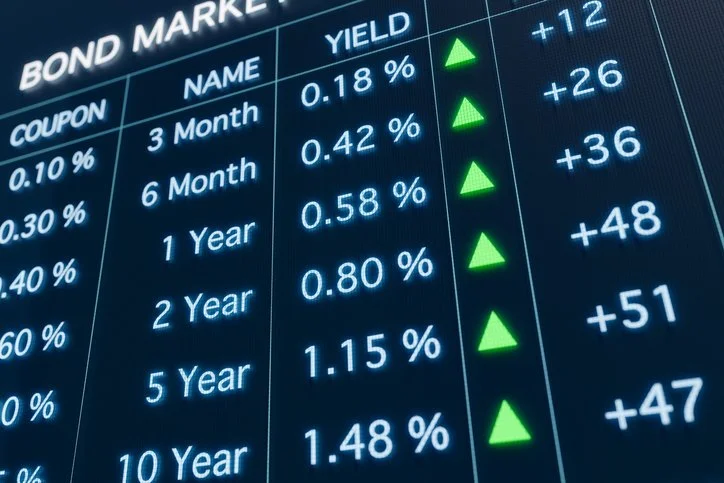
Yield Curve: A graph of the relationship between maturities and yields on bonds. A normal yield curve is upward sloping, with longer-maturity bonds paying higher yields.


Back to Top

Z

Zero-Coupon Bond: A bond that does not pay any interest payments until maturity. Such a bond is usually sold at a discount to face value, and then pays its face value at maturity. The difference between the sale price and the face value represents the interest received.


Back to Top

278 S. University Drive
Plantation, FL 33324
Phone: (954) 693-0030
Toll Free: (866) 229-1356
Fax: (954) 693-0031


Contact an Advisor